
Please see the attached pdf file for the encyclical in English.

For Sunday, 17th October Homily Reflections for our first 25 years as a Parish
17/10/2020In September we celebrated the Feast of the Holy Cross. There are many ways we can think to the Cross and Our Saviour’s sacrifice upon it. One aspect which we do no often reflect upon is that Our Lord was martyred. He was the Protomartyr. For what is martyrdom; it is avoiding anything, any false teaching, any person, and any event which separates us from God; and it the upholding of this Truth without any deviation from it.
The Jews looked for a Messiah. They wanted a Messiah who would be a great leader in human terms; one who would raise an army and overthrow the occupation of the Roman Empire. They wanted a Messiah who would affirm that they held the correct understanding and interpretation of the Law; they wanted him to affirm that they were right. And so, they had no time for the Gospel preached by Our Lord; Love your enemies, be born again, become like little children, understand the Law differently; cursing a brother is murder, looking upon a woman with desire is adultery &c. Indeed, the whole of His teaching they wanted to set aside; to continue to be Pharisees rather than publicans. They did not want to follow the wisdom of the common man. Which leaders ever do? But Our Lord could not deviate from the Truth, He could not become the one they wanted. He was the Messiah but nor one acceptable to the Jewish leaders and, hence, he was put to death, martyred!
In this year we celebrate our 25 years as a parish and, in this, we have been potential ‘martyrs’. We have held the truth of the Holy Orthodox Church. In our personal lives and in our life together we have upheld this truth, ensuring that, as far as possible, we have not deviated from it, nor have we allowed ourselves to be swayed from it this way or that. We have tried to ensure that nothing, no teaching, no-one, no event has pulled us away from the truth of Christ's Gospel as understood in the Church. Of course, we have oft-times failed but our heart has been rightly directed. If we have suffered, been persecuted, been mocked or despised, for our belief, then we have suffered ‘martyrdom’ not of blood but of fidelity. (Perhaps giving up the church in Carlton and refusing to be involved in a legal wrangle was part of this martyrdom; when asked for our coat we gave our cloak as well, as Our Lord instructs in Matthew 5:40).
So, we can be justly grateful for this time of great blessing.
We have been well provided for. At this time, I celebrate 25 years since my ordination to the priesthood of the Holy Orthodox Church. I served my first Liturgy on the Feast of St Thomas 6/19 October. We became a Parish at Pentecost in 1995 but then we had a resident priest from October that year. Later Fr Peter was ordained and more recently Fr Julian. For many years we have had the devoted service of Fr Dn Ian. Yes, we have been greatly blessed. We were welcomed in our first year by the use of St Mary’s in the Lace Market, one of the oldest churches in Nottingham. Later were able to purchase our own church in Carlton. Then we moved to St Leodegarius, an even older church foundation than St Mary's and then we moved to St Aidan’s, perhaps arriving at last at a most suitable home; a Church dedicated to St Aidan, where we have been given such a good and firm welcome. We should also add that there are now two parishes in Nottingham welcoming British people into the Orthodox Tradition, whereas before 1995 there was not one so designated.
So, we celebrate with grateful thanks these 25 years, this Jubilee, and look forward to the next 25 years ahead. I hope that I have been a sufficiently good priest in these first 25 years and I ask your forgiveness where I have failed. Now we have Fr Julian to be priest for the next 25 years, I, God willing, shall not be with you for the whole of the next 25 years but perhaps for some years to come.
Rejoice with me, be thankful with me, may all our failings and shortcomings be forgiven, but may we go forward with the blessings of Christ Our Lord, remembering His words in Psalm 77; “ Hear my Law, O my people: incline your ears unto the words of my mouth. Let all put their trust in God and keep His commandments.”
Let us go forward in Joy and Peace.
Fr David, celebrating his Jubilee Year.
Matthew the Tax Collector - Luke 5: 27-32
15/10/2020As strange as It seems to many, I do not drive. My father did begin to teach me, but I had no real enthusiasm. When I was very young, I did rather think I would like a “Bubble Car”.

Bubble cars are a kind of Microcar mostly produced in Germany during the 1950-60. The term ‘Microcar’ is used for the smallest size of car with three or four wheels and often an engine smaller than 700 cc Microcars are classified by governments separately to normal cars, sometimes using the same regulations as motorcycles or mopeds. Therefore, compared with normal cars, microcars often have relaxed requirements for registration and licensing, and can be subject to lower taxes and insurance costs.
Now You may be thinking that the link to our Gospel reading is ‘Tax’. Jesus sees Levi, sitting at the tax office and invites him to ‘follow’. Levi then entertains Jesus with a great feast, at which there is a great number of tax collectors. Bubble cars, as stated above, are subject to lower tax and relaxed requirements.
So, there is a link, but it’s not the one. (Bear with me!)
I once heard that a well-known celebrity owned a Bubble Car and used it to drive to an audition. Seeing a parking space at the studio he drove straight into it and stopped in front of a wall just ahead of the time of his audition. Now, what he had forgotten was that most Bubble Cars do not have a reverse gear, and as you can see from the picture above, a bubble car has one door and that is at the front of the vehicle! So, unable to open the door because he had pulled up to a wall and not having a reverse gear, and in the days before mobile phones, the celebrity missed his audition and remained stuck in his car until his yells were heard by a kindly passer-by.
For many people, driving without a reverse gear would be unthinkable.; how would you ever get out of the garage? There are times when one needs to go backwards to go forwards. (here comes the link!).
A reverse gear may only be needed a few times a day, but it is essential when you need to back your car up!
In v32 of our gospel reading Jesus says, “I have not come to call the righteous, but sinners, to repentance”. Repentance is like having a reverse gear; You don’t just do it once. You do it daily and maybe 4 or 5 times a day!
In fact, there can be no forward motion in ‘Christlikeness’ without repentance. You cannot journey with our Lord without reversing–and reversing often. Becoming and being a disciple of Jesus requires repentance all the time. Every time we repent it is an opportunity to move forward. There is no other way to get out of the garage!
It is, of course essential, that we fully understand what is meant by ‘Repentance’
Repentance is the feeling and act in which one recognizes and tries to right a wrong or gain forgiveness from someone whom he/she has wronged. For those of us who profess the Christian faith, repentance usually refers to repenting for a sin against God. It always includes an admission of guilt, and also includes at least one of the following:
- a solemn promise or resolve not to repeat the offense;
- an attempt to make restitution for the wrong,
- or in some way to reverse the harmful effects of the wrong where possible.
In Biblical Hebrew, the idea of repentance is represented by two verbs: שוב shuv (to return) and נח�? nicham (to feel sorrow).
In the New Testament, the word translated as 'repentance' is the Greek word μετάνοια (metanoia). Metanoia is primarily an after-thought, different from the former thought; a change of mind accompanied by regret and change of conduct, "change of mind and heart", or, "change of consciousness".
Repentance is often viewed as a negative. Indeed, there is a negative aspect to repentance in that it has to do with the past and presupposes the recognition of an abnormal state of affairs, a wrong direction, a state of sin. When one begins to repent one is recognising that he/she is on the wrong road and needs to change direction.
There is however a positive aspect to repentance too! This has to do with the future and opens up a new way for the repentant sinner, a new way of life, a radical reorientation, a new road to travel.
Thus repentance is on the one hand an acknowledgment and cessation of sin, and on the other hand a resolve to accept the challenge of a new life, a new road to journey upon.
According to general scholarship, the first recorded words of Jesus are recorded in Mark 1:15 (as it was considered the first Gospel that was written):
"This time is fulfilled, and the kingdom of God is at hand. Repent and believe in the gospel."
There was nothing new in this call to repentance; Elijah told the people to repent, Isaiah told the people to repent, Joel told the people to repent, Jonah told the people to repent, Jeremiah, Micha, Amos and Malachi all had a message of repentance.
And that message hasn’t changed!
Jesus Forgives And Heals A Paralytic - Luke 5: 17-26
3/10/2020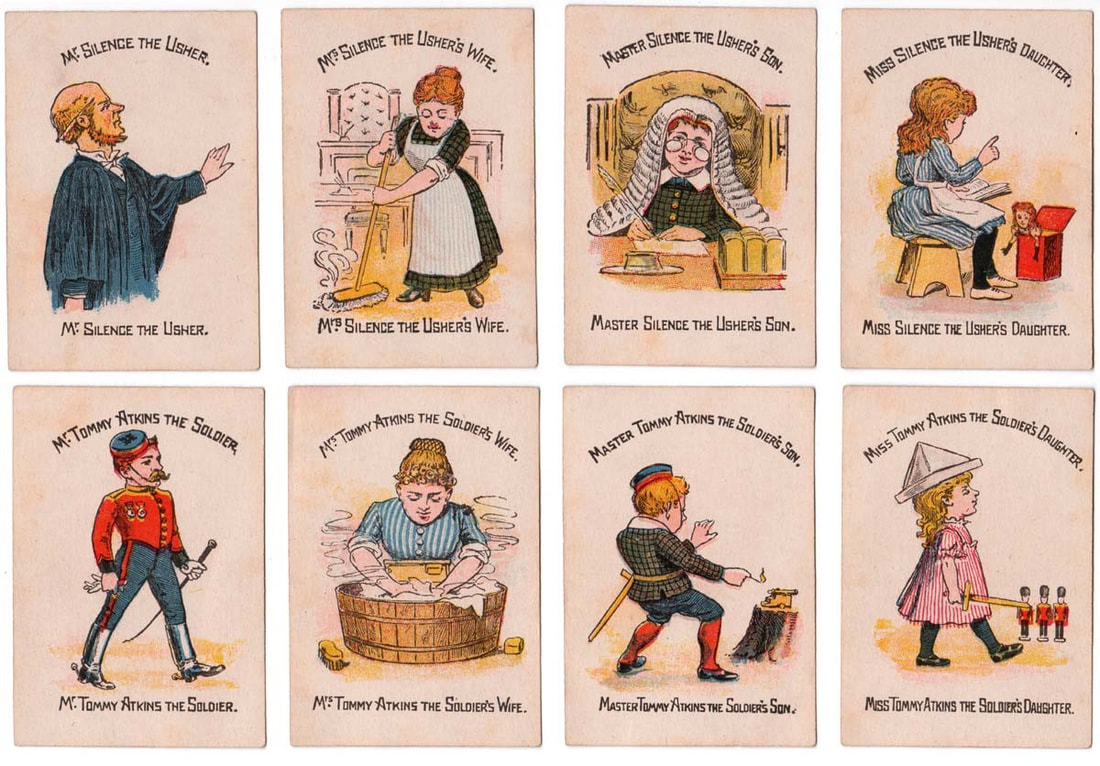
It’s interesting isn’t it, what we remember from our childhood? I have found memories of playing traditional games like ‘Snakes & Ladders’, Ludo and ‘Happy Families’.
Do you remember ‘Happy Families’? This is a card game where the object is to collect sets of fictional families of four, most often based on occupation types (see above). These games were always great fun (so long as my Dad won!).
One of the things I remember from my early school days was sitting, cross-legged, on the floor for morning assembly. I have a very clear recollection of hearing the story of the ‘Lame’ man being lowered through the roof of a house.
I am sure that the events recorded, in the Gospel reading for today, are well known to many of you; Jesus was teaching the people and they gathered in such large numbers that there was no room left inside the house where he was teaching, not even outside the door. Some men came carrying a paralysed man but could not get inside, so they made an opening in the roof above Jesus and then lowered the man down. When Jesus saw their faith, he said to the paralysed man, "Son, your sins are forgiven." Some of the teachers of the law interpreted this as blasphemy, since God alone can forgive sins. Jesus said to them, "Why are you thinking these things? Which is easier: to say to the paralytic, 'Your sins are forgiven,' or to say, 'Get up, take your mat and walk'? But that you may know that the Son of Man has authority on earth to forgive sins …" He says to the man "...get up, take your mat and go home."
If I am honest, I have to say that it was the lowering of the man through the roof, that at that time, seemed to be the most interesting aspect of this story. As I read through the Apostle Luke’s account today it is the attitudes of the people listening and watching Jesus that strikes me. Firstly, we have two basic groups of Jewish people. The first group was made of those who enjoyed listening to Jesus. They saw him as a wise teacher and prophet.
Then we have the Pharisees and teachers of the law. They came to listen too, but not to learn. St Luke reports that the Pharisees and teachers of the law were sitting whilst Jesus was teaching (v17). In Jewish culture of the time, teachers sat and taught while students stood. Probably Jesus was sitting as well, but the Pharisees wanted to be seen as equals to Jesus, as ones who did not need to learn anything from Him, but as those who would listen to what He taught in order to find fault and judge the validity of the teaching. Later, in response to Jesus telling the paralysed man that his sins are forgiven, these Pharisees and teachers see Jesus as a Blasphemer (v21). They came to find fault with Jesus’ teachings and that is just what they did!
We also have those who came, not so much for themselves, but for their paralysed friend, hoping that he would be healed by Jesus. It is clear however, that they saw Jesus as more than simply a healer. In v20 we read that Jesus “saw their faith”. These men placed their faith, and their friend, in the hands of Jesus. They believed the words Jesus taught and that the Kingdom of God was at hand.
And of course, we have the paralysed man himself who was prepared, not only to allow his friends to help and intercede for him but was also willing to obey our Lord’s instructions. Did he see Jesus as more than a ‘Healer’ too? Yes, I think so. When Jesus tells him to “arise, take up your bed, and go to your house”,(v24) that is precisely what he does – with unquestioning faith! And of course, the healing received was, in all probability, so much greater than expected. Not only a physical transformation, with atrophied muscle strengthened and rebuilt but spiritual too, with his sins being forgiven (v21).
They all saw Jesus, they all heard Jesus, they all witnessed his ministry. Jesus the teacher, Jesus the healer, Jesus the prophet, even Jesus the blasphemer! It’s a little like ‘Happy families’ identifying and collecting occupations!
How we see Jesus is no game! Amongst other things Jesus has been thought of as a healer, a moral teacher, a reformer, an apocalyptic preacher, a radical, a revolutionary, a Jew, a prophet, a social revolutionary, and, ultimately and most importantly, the Messiah. St Peter wrote, “whom having not seen you love” (1 Pet 1:8). And it’s true, we haven’t seen Jesus with our physical eyes. But all who belong to Him do see Him (Heb 2:9), for we see with spiritual “eyes” (the eyes of understanding, Eph 1:18).
Whatever our thoughts are occupied with, that reflects the kind of life we lead. If our thoughts are quiet and peaceful, kind and loving, there’s peace for us; and if they are negative, there’s disquiet and restlessness. Whatever our thoughts about Jesus, how we see him, will reflect in the relationship we have with him. If we see him as a judge, we will look to be judged. If we see him as a father, we will struggle to have a safe and loving relationship with him if we have suffered abuse at the hands of our father.
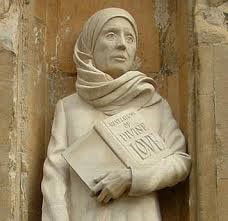
There are many who can help us to ‘open to eyes of our understanding who can help us to see and understand our Lord. Few better than Julian of Norwich;
“And after this our Lord shewed Himself more glorified, as to my sight, than I saw Him before [in the Shewing] wherein I was learned that our soul shall never have rest till it cometh to Him, knowing that He is fulness of joy, homely and courteous, blissful and very life.
Our Lord Jesus oftentimes said: I it am, I it am: I it am that is highest, I it am that thou lovest, I it am that thou enjoyest, I it am that thou servest, I it am that thou longest for, I it am that thou desirest, I it am that thou meanest, I it am that is all. I it am that Holy Church preacheth and teacheth thee, I it am that shewed me here to thee. The number of the words passeth my wit and all my understanding and all my powers. And they are the highest, as to my sight: for therein is comprehended—I cannot tell, — but the joy that I saw in the Shewing of them passeth all that heart may wish for and soul may desire. Therefore, the words be not declared here; but every man after the grace that God giveth him in understanding and loving, receive them in our Lord's meaning”
And from the time that it came to me, I often desired to know what our Lord’s meaning was. After fifteen years or more, I received an answer, saying to me: ‘What, would you like to know the Lord’s meaning in this thing? Know it well, love was his meaning’.
Sunday of the Elevation of the Holy Cross
18/9/2020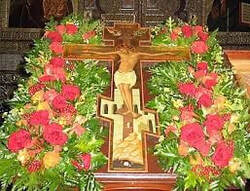
“The Cross is the protector of the whole world; the Cross is the splendour of the Church; the Cross is the glory of kings; the Cross is the support of the faithful; the Cross is the glory of angels and the terror of demons!”
(Exapostilarion for Wednesdays and Fridays)
What an amazing joy it must have been when the Holy Cross on which Our Saviour had been crucified was discovered in 327AD. The Emperor Constantine asked his mother Helena to visit the Holy sites in Jerusalem and to her joy the Holy Cross was discovered. Following this, soon afterwards, The Church of the Holy Sepulchre was built. Over the centuries, the Cross has become the most important sign of our Salvation, indeed we venerate it with great honour for the Cross was not only the instrument of Our Lord’s shameful, yet life-giving death but it was also THE TREE OF LIFE. The Tree of Life noted in the Garden of Eden was guarded by angels once Adam and Eve had fallen from grace and disappeared from view. Now it was brought into view again in the form of the Holy Cross. Thus, we have in our midst the Tree of Life, the enduring sign of our Salvation and the new life brought to us by Our Lord who sacrificed himself upon it.
“When the Cross was planted on earth, the arrogance of the demon fell and disappeared, for Adam returned to Paradise from which he had once been expelled. Paradise was opened for all; glory to You, O Holy God, who have willed so to do!” (Canon, Tone 2)
In the Gospel for the Sunday after the Feast (Mark 8: 34 ff), we have these challenging words from Our Lord:
“ Whoever desires to come after Me, let him deny himself, and take up his cross and follow me.”
What does this mean? It means that we are to embrace fully our life in Christ and ensure that this is at the forefront of all our earthly thoughts and endeavours. Taking up the Cross is not negative and a punitive burden but the very fullness of our life. John Henry Newman, now declared a Saint by the Roman Church, says this:
“Fear not that life may come to an end but rather fear that it may never have had a beginning.”
This is why St Paul in his letter to the Romans gives this understanding:
“None of us lives to himself. and no one dies to himself. For if we live, we live to the Lord; and if we die, we die to the Lord. Therefore, whether we live or die. we are the
Lord’s” (Rom 14: 6-9).
We are to do all for the Lord, and in our life together, for only in this, is life in fullness. The Holy Cross reminds us of this, everyday, as we gaze upon it. We receive the challenge again and again: THIS DAY TO TAKE UP THE CROSS that your life may be transformed; that you may enter into the fullness of life.
St Paul also says;
“ The message of the Cross is foolishness to those who are perishing, but to those who are being saved it is the power of God”.
It seems that the Leaders of the Established Church of this land have been silent at a national level, throughout the whole of this coronavirus episode . At a national level there has been no comforting and no encouragement and no enlightening guidance on offer. Above all there has been no voice of prophecy giving a clear message of what the Church is about and what the Gospel of Christ has to offer. No proclamation that the message of the Cross is the power of God to those who seek to be saved and live life to the full. Just quoting St Paul and St John Henry Newman as above could have been a focus of such prophecy. It has to be proclaimed loud and clear, that the way forward for the nation, is not only to overcome the Coronavirus, and to restore the economy, though this is necessary. Rather, it is for all to realise that without God, our Creator and the one who has given us new life, there is no real life and there is no safe future. This land and its people must return to Christian roots for sustenance and life and a new way forward. As Saint John Henry said; all should “fear not that life may come to an end but rather fear that it
may never have had a beginning”. Only life in God gives fullness of life. Without God at the helm, all is lost.
On this day we hold high the Cross, the Life Saving Cross, the Tree of Life and challenge ourselves and all in this land to live for Christ, to take up the Cross of love, the Cross of salvation. The Cross can lead us forward to renewal and fulfilment of life. For “The Tree of Life, the true spiritual vine, is hung upon the tree of the Cross, as a fountain of sweet healing wine for all mankind” (Sunday, tone 4, matins ode 3). We are now lifted up, by the Cross, from the Fall; and saved from the destructive wood of the forbidden tree.
Fr David