The Orthodox Parish of St Aidan & St Chad, Nottingham (EP)

Anticipating The Universal Exaltation (Elevation) Of The Precious And Lifegiving Cross

14/9/2020

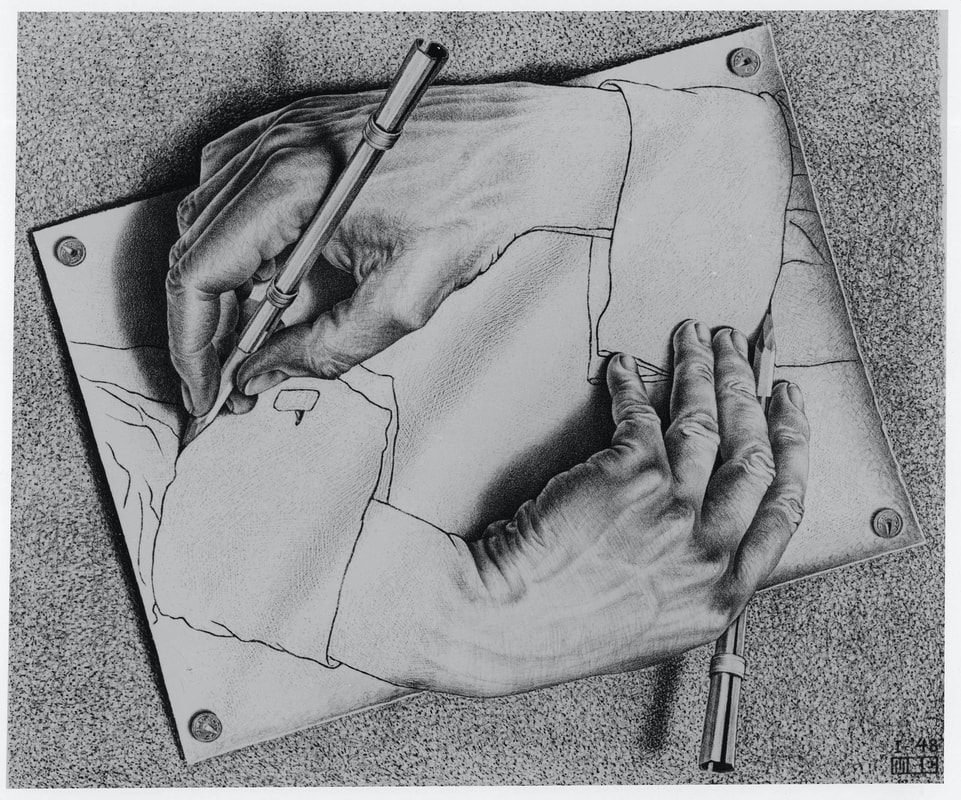
As one looks at the drawing above; we see a hand drawing another hand, but which is drawing the first hand, but which hand is drawing which? Our mind is challenged, it doesn’t make sense!
This is so often true also of the faith we profess. We are often called to flip things upside down, to view things from a different perspective, to accept that, which to many, makes no sense or is illogical. It is all so paradoxical.

Interestingly, Orthodox and Paradox are two words having much in common. The "dox" that ends both terms have roots in the Greek word doxa, which means "belief" or "opinion."(In later Christian usage, doxa came to mean "glory," but only as an extension of its much older philosophical meaning, which is "belief"). “Ortho” has a Greek root meaning to straight, correct, or upright.And so, if a doxa is an opinion or a belief, then ortho-doxa is a "correct or right belief."Similarly**,** the prefix “para” has a Greek root meaning "beyond" or "outside of"; and so, something that is "para doxa,", is beyond belief, contradicting what we might commonly believe to be true.

For many, that which is ‘Orthodox’ often appears to be a ‘Paradox’. For instance, we are monotheists, we believe in one God. But we call that God a Trinity, one God in three persons; but how can God be both 1 and 3? – A paradox?  Again, The Orthodox Church believes that Our Lord, Jesus, while on earth, was fully Immortal God and, at the same time, fully Mortal Man. How can He be both? And then of course we have the Mother of our Lord; A virgin mother?

"O Mother that hath known no man, thou didst conceive, not experiencing corruption,
lending a body to the Word, 
the Creator of all, becoming a receptacle to thine insupportable Creator,
a dwelling-place to thine incomprehensible Maker."
________________________________________

On Monday it is the feast of  The Elevation of the Holy Cross, also referred to as the Exaltation of the Cross, one of the Great Feasts of the Orthodox Church.  This feast commemorates two events: Firstly, The finding of the Cross by the Empress Helen (the mother of St. Constantine the Great) on Golgotha in 326 AD, the place where Christ was crucified. Then recovery of the Cross from the Persians who had taken the Cross as a prize after sacking Jerusalem in 614 AD. It was recovered by the forces of the Byzantine Empire in 627 AD. The Cross was taken into the temple of the Resurrection, where it was joyously held up for veneration by the faithful.

Now, when it comes to a paradox, is there anything more paradoxical than the Cross of Our Lord?  As the Apostle Paul writes 1 Corinthians I: 23,
“But we preach Christ crucified, unto the Jews a stumbling block, and unto the Greeks foolishness;”

The Apostle tells us that the Jews seek signs because that is what the prophets gave them, although even then they did not believe. Their expectation of the Messiah was of one who would triumph over Israel’s enemies and establish Jerusalem as the centre of the world. Death by crucifixion was shameful and unthinkable. Their Messiah was to be exalted, not humiliated.
Greek speculative philosophy generally regarded the realm of the spirit and ideas as good and vastly superior to the inferior world of matter. With such a world view the whole idea of a God who became man and assumed the limitations of mortality by assuming a material body subject to suffering and death, was unthinkable. For Greeks salvation was through the mystical reception of knowledge, which would free them from the bondage of the physical world and enable them to share in the spiritual realm. The whole cycle of creation and redemption was unthinkable to them.

At the heart of the Orthodox Christian mysteries there is usually a paradox: The Creator who becomes a creature; the virgin who gives birth but remains a virgin; of the way to life being through death; of the poor being rich; of the weak being strong. To the unbeliever it is simply contradiction and disingenuous, proving the foolishness of the Gospel, and the credulity of Christians. To the believer, however, the wisdom of God is not the same as the wisdom of this world. Origen states that it is the world’s wisdom that is foolish “even though the simplicity of God’s wisdom makes those who have it appear foolish in the eyes of the world. Believers have received this divine wisdom and thus in this world appear to be fools.” It is not surprising therefore that the Orthodox Church has a whole category of saints known as “Fools for Christ.”

From an object of destruction and shame, the cross has become the emblem of pride and respect. We raise it high over our churches; we decorate our most sacred objects with it whether they are buildings, or fabrics; we suspend it around our necks; we sign ourselves with the cross when we begin our prayers; we use it to bless our food. The Cross is a ubiquitous and potent symbol. In itself it is a means of grace. Saint Antony the Great speaks of defending himself by faith and the sign of the cross.

Drawing Hands,
Drawing by Maurits Cornelis Escher (1898-1972), Drawn in 1948, Pencil on paper
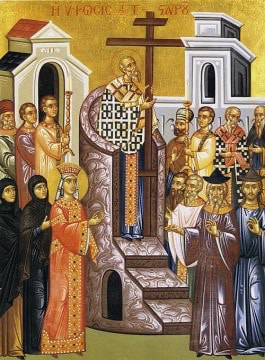
Troparion of the Exaltation of the Cross

O Lord, save Thy people, and bless Thine inheritance.
Grant victories to the Orthodox Christians over their adversaries;
and by virtue of Thy Cross, preserve Thy habitation.

Homily - A Trap for Jesus

5/9/2020

The 13th Sunday After Pentecost
(Matthew 21: 33-42 – A trap for Jesus)

I remember once being told that, on becoming a Christian, the last thing to be converted is your wallet! For many people money and finances are considered to be very personal and of course we often hear the misquoted 1 Timothy 6:10, “the love of money is the root of all of evil”.
But what do we really know about money?
For instance, did you know that Pound sterling is the world's oldest currency still in use. That most banknotes contain traces of cocaine. With so much anxiety about hygiene and cleanliness, did you realise that the average European banknote is home to 26,000 colonies of bacteria. Perhaps you think that the penny in your pocket isn't worth very much? Uzbekistan's tiyin is worth around 3,000 times less than a British penny.
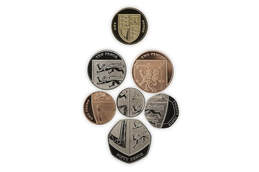
How about this one! Did you know that one can arrange the newer 1p, 2p, 5p, 10p, 20p and 50p coins to reveal an esoteric shield design that mimics the coat of arms on the £1 coin? This clever feature was created by designer Matthew Dent in 2008.

                              
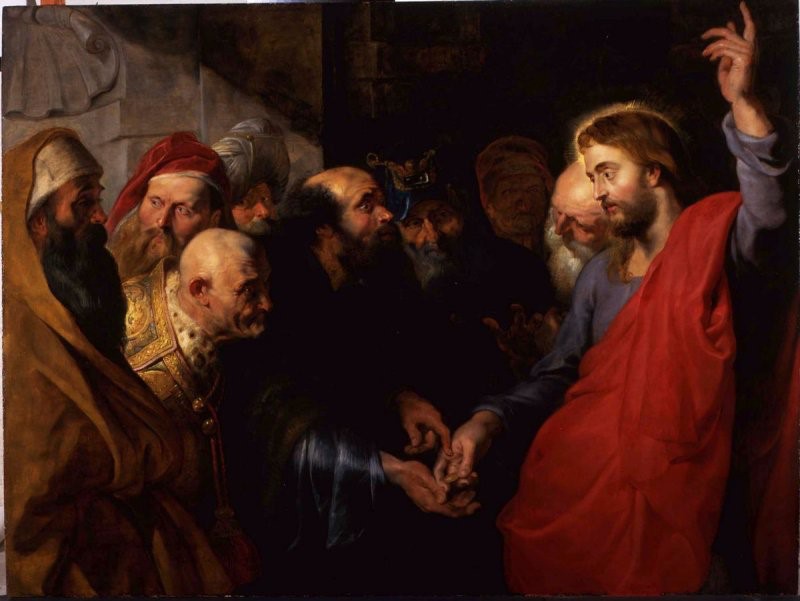
It would be easy to think that our Gospel reading was about money and whether the Jews should pay taxes to the Roman authorities. The Pharisees and the Herodians anticipated that Jesus would oppose the tax, their purpose being to hand him over to the power and authority of the governor. The questioners flattered Jesus by praising his integrity, impartiality, and devotion to truth. Then they asked him whether or not it is right for Jews to pay the taxes demanded by Caesar.  Jesus first called them hypocrites and then asked one of them to produce a Roman coin that would be suitable for paying Caesar's tax. One of them showed him a Roman Coin (a denarius, and he asked them whose head and inscription were on it. They answered, "Caesar's," and he responded: "Render therefore unto Caesar the things which are Caesar's; and unto God the things that are God's". The questioners “marvelled"; unable to trap him any further, and being satisfied with the answer, they went away.
Because the denarius bears the image of Caesar it is right and proper to give it to Caesar.

What if we extend this same principle to ourselves, we each bear the image of God; we therefore belong to God. So, what does that require us to render to God?
The answer of cause is EVERYTHING! God is Lord over all!

Interestingly; the value of 6,000 denarii was equal to one talent. A talent being a unit of weight of approximately 80 pounds (36 kg), and when used as a unit of money, was valued for that weight of silver.

Now, we may not possess denarii but we each have a few ‘talents’, natural aptitude or skills; talents that we can offer for the service of our Lord. But, perhaps more importantly, we each have many gifts. As the Dutch Catholic priest, professor, writer and theologian, Henri J.M. Nouwen reminds us these gifts are how we express our humanity, they are a part of who we are; friendship, kindness, patience, joy, peace, forgiveness, gentleness, love, hope, trust and many, many more. These are true gift; gifts that have the power to bring healing to the deepest hurts.
However, A gift only becomes a gift when it is received and accepted by another and we can be sure that anything that we offer to our Lord with love and faith will be received  “ …and it will be given to you: good measure, pressed down, shaken together, and running over will be put into your bosom. For with the same measure that you use, it will be measured back to you.” [Luke 6:38] 

With prayer and love in XC
Fr Julian

Caesar's Coin, by Peter Paul Rubens (1612-1614)

Homily - After-feast of the Dormition

16/8/2020

In my homily for St Seraphim’s Feast on the third Sunday of July, I referred to his understanding of our Orthodox faith. He reminded us of the importance of our baptism, restoring us as we should be and, by associated chrismation, giving us ‘the seal and gift of the Holy Spirit - the most precious gift we can ever receive’. He added, ‘The grace of baptism is so great and so indispensable to mankind, so life-giving that it is never taken away’. even if we fall into error, the grace remains with us.

St Seraphim continues, ‘If, after our baptism, we never sinned, then we would be eternally holy, blessed, God-bearing, pure and free from all impurity of body and spirit, pleasing to God. However, the trouble is that gaining in age, we do not gain in grace, or in godly wisdom, as Our Lord Jesus Christ did. Instead, we gradually become corrupted, denying ourselves the grace of the All Holy Spirit of God, and becoming, in varying degrees, sinners, yes, most sinful people’, We fall away from what we should be.

Here is our aspiration and our failing; good intentions but difficulty achieving them. Yet there is one who held fully to these aspirations and did not fail, and she is our exemplar and one for whom we should give thanks, praise and follow.

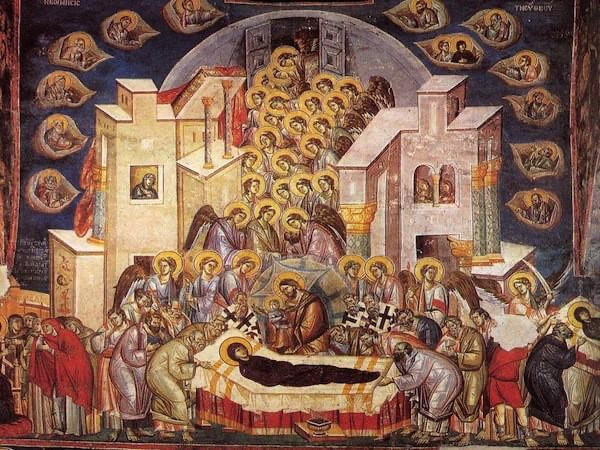
Yes, on this day, when we celebrate the Dormition of the Most Holy Mother of God, we remember the Most Holy Birth-giver of God, even Our Blessed Lady and Ever Virgin Mary. She was the one who did not fall into corruption (sinfulness). Born of ageing parents, through the special grace of God, she remained innocent and pure as all children born to mankind. In her, this purity and innocence continued. She became prayerful, attentive to God, ready to be the first Christian Saint when called to be so.

Although the devil deceived Eve and she together with Adam fell from God, in due time He found a woman, so pure, prayerful (totally in tune with Him) and lovely, that He was able to give us the Saviour born of her seed. She filled with the Holy Spirit, and with her eternal motherly care, not only gave birth to and supported her son but in doing so, crushed within herself the serpent’s head. She was not immaculate by conception, but by prayer and faithful attentiveness to God. Hence, the Church is able to sing out:

O blessed Lady, the creator of All dwelt bodily in your womb in order to refashion mankind which was fallen and wandering because of the serpent. For our sake, you ineffably gave birth to our God in the flesh, thus, delivering from death and renewing the human race. Wherefore, we sing and glorify the grace given you by God, O pure Virgin, unwedded Bride, and entreat you to be delivered from all suffering.........He  ineffably emptied Himself    within your womb; and rising from you like a Sun, He shed the light of His Divinity upon the whole world, delivering it from the darkness of idolatry. (Aposticha, Saturday vespers, Tone 4).
‘The Fire of the Divinity dwelt in you and nourished the Lord and Creator of all’.

To follow the Holy Mother, as St Seraphim inspires us, the aim of our life, like hers, is to acquire the Holy Spirit. ‘Fasting, vigils, prayer, chastity and all other good deeds done for the sake of Christ, however good they are, do not alone, constitute the aim of Christian life. The aim of our life is to understand what doing good deeds for Christ really means; it is the grace of the Holy Spirit, which these works bring us. It is by gaining and acquiring this grace (achieved through good deeds) that alone is the aim of Christian life’.  Good deeds done for the sake of Christ bring forth the fruit of the Holy Spirit since the Holy Spirit came into the world for the sake of Christ.
But, ‘If not done for the sake of Christ, (a good deed) does not bring the blessing of the Holy Spirit’.

All good deeds are pleasing to God. Everyone who loves God and does what is right is pleasing to Him. Here is the key; Love God and not just goodness alone. What is important is not virtuous deeds on their own but what is given through these deeds, namely the fruits of the Holy Spirit and increasing love of God.

The Holy Spirit prepares in our soul the throne of God dwelling with our spirit, in accordance with the Word of Our Lord. As scripture says, ‘I will dwell in them, and walk among them; I will be their God, and they will be my people (Leviticus 26:12, 2Corinthians 6:16). This is the Oil that keeps the lamps burning. Or, as Our Lord said to the Samaritan woman, ‘The water that I shall give shall be a well of water springing unto eternal life’.

On this Feast of the Birth-giver of God, we remember that she is the only one of the human race who lived her whole life filled with the Holy Spirit and continues so in her heavenly throne. We must always honour her and know her important role in God’s saving plan. She exactly shares the fullness of the humanity of the son born of her which why, at her Falling asleep, she realised the first fruits of her son’s Resurrection and was. thus, bodily lifted into heaven.

Most Holy Mother of God pray for us and hold us in the saving grace of your Son.

Fr David

Homily - Transfiguration

6/8/2020

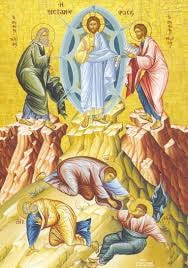
Today is the Feast of the Transfiguration and to Orthodox Christians the Transfiguration is a very special event in the Christian year. There is a sense in which it sums up the whole mystery of the Incarnation, and beyond that, the mystery of Creation itself.

A first thing to note about the Transfiguration is that it was a very secret event. There were only three witnesses: Peter, James and John. Why only three of them? Why not the Twelve? The obvious answer is that this event was so mysterious and so holy that it was only vouchsafed to a small inner circle. It is as if they had entered an inner sanctuary where life’s deepest secrets are revealed. Of all the Israelites who came out of Egypt, only Moses saw the glory of God – and even he was not permitted to see God face to face. On Mount Tabor however, Christ manifested his glory to three persons – a sort of human trinity – and they were permitted to gaze on his glorious and transfigured Face. On one level it was the mystical proof that Christ was God; and it was given to them to see it, as the Kontakion of the Feast tells us, so that when they saw Christ crucified, they might know that his sacrifice was voluntary.

But there is another layer of meaning in the Transfiguration; or perhaps I should say another layer of manifestation. Orthodox Christians have always seen the great events of Christ’s life in cosmic terms: in their relation not just to ourselves and to the whole of the human race, but to the whole of creation. Thus when Christ was conceived in the womb of the Virgin, he took to himself the material substance of the Universe and sanctified it. At his Baptism in the River Jordan, he effectively baptized the waters of the earth; and at his Transfiguration he manifested God’s glory in the material world.

This is one of the central truths of the Christian faith: that life does have a divine aspect, and that there is in this world a hidden glory which, however fleetingly and however selectively, is sometimes revealed to us. As the poet Wordsworth said of his own adolescent experiences:

There was a time when meadow, grove and stream,
           The earth, and every common sight,
                       To me did seem
                  Apparelled in celestial light:
           The glory and the freshness of a dream.

To put it simply, matter is spirit-bearing. Great music is more than just an arrangement of sounds; great buildings are more than just stones and mortar. To those who can see discerningly, trees are living Presences, the wings of a great bird are like those of an angel, fire is a mystical portent, and the human face is sometimes suffused with the glory of the divine. Evolution itself bears witness to the gradual spiritualization of things. At each stage in the development of the Earth, new spiritual principles are disclosed: the glorious flowering of the plant kingdom, the conquest of the air, feathers, bird-song, animal parenthood and recreation; the gradual emergence of beauty and love. Even the very processes of erosion work to disclose the glory of the Creator, distilling beauty our of flux, fragmentation and change. By contrast sin and evil make things look more purely physical, because the effect of evil is to kill the life in things. Bad people tend to have bad faces; hatred cannot don the mask of beauty – at any rate in its higher manifestations; and when people and societies cease to believe in spiritual things they begin to produce soulless buildings, soulless communities, soulless entertainment – and soulless lives. The world is a book of strange and wonderful symbols, waiting to be read. If we would see God’s glory we have only to cleanse the doors of perception and look about us.

There is one other thing. Of all the great Feasts in the Christian Year the Transfiguration is most obviously a touchstone of our worship. ‘Lord,’ said Peter in his terror, ‘it is good to be here!’ Yes, it was good, but it was also a soul-shaking experience. Glory, radiance, beauty beyond all human telling, so that the Apostles felt compelled to bow their faces to the earth and adore. Now in its original sense, Orthodoxy means ‘right worship’; and without in any way wishing to disparage non-Orthodox Christians, who sometimes lead more Christ-like lives than we do, it does seem to me that it is only Orthodox worship, in its ineffable and celestial beauty, in its sometimes overwhelming sense of the Divine Presence, that enables us to understand what worship is really all about. And there, it seems to me, is a message for our godless, utilitarian Age, and a truth that we do well to ponder.

Deacon Ian.

Homily - The 8th Sunday After Pentecost.

2/8/2020

Matthew 14: 14-22
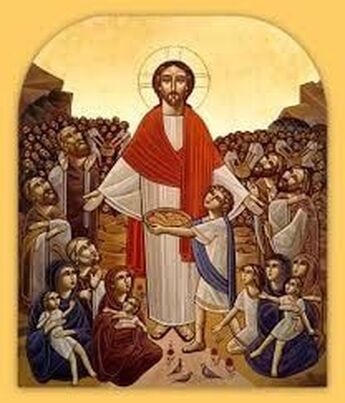
Feeding of Five Thousand

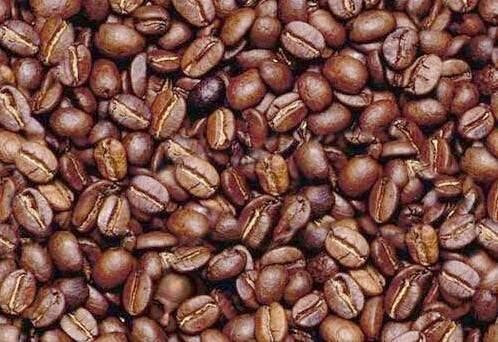
Can you find a man's face hidden among the coffee beans?
Trust me, he's in there.

Knowing that there is a face hidden in the picture doesn’t necessarily make it easy to find. Not knowing it is there would render it virtually impossible to notice. The way we look at something will determine what we are likely to see. This is as true for our reading of the Holy scriptures as much as for anything else.

In the history of biblical interpretation, four major types of hermeneutics (the branch of knowledge that deals with interpretation, especially of the Bible or literary texts) have emerged: the literal, moral, allegorical, and anagogical. I wonder how you interpret today's Gospel reading.

Matthew 14 tells us how Christ fed the multitudes – 5000 men plus the women and children. Have you ever noticed just how that is done? First, we have Christ giving thanks. We then have the bread being broken and distributed - Familiar?

Christ gives thanks - Just as we offer the Anaphora or the "Great Thanksgiving" The central prayer of the Eucharist.
Christ breaks the bread – Just as the priest breaks the bread representing our Lord’s body; the Eucharist.
Christ gives it to his disciples to distribute - representing the Priest distributing communion at the Liturgy,
Finally; the people are filled!

When we gather together for the Divine Liturgy we partake in the greatest of miracles! As the priest stands at the altar, he says, “The Lamb of God is broken and distributed, broken yet not divided, ever eaten, yet never consumed; but sanctifies those who partake.”

After all had eaten of the 5 loaves and 2 fish in today’s gospel account, there are taken up 12 baskets full, one for each of the 12 apostles; and these baskets have been passed down from the apostles into the hands of the bishops and priests in every generation and remain ever full – ever eaten yet never consumed!
Is there anything more important than to receive the “most precious and holy Body and Blood of our Lord and God and saviour, Jesus Christ, for the remission of sins and for eternal life”? – what the Fathers call the “Medicine of Immortality.”

The ‘feeding’ miracle(s) are offered to us by all four of the Gospel writers, and in John chapter 6 Christ explains the true significance (John 6:48,51- 56) “I am the bread of life… Most assuredly, I say to you, unless you eat the flesh of the Son of Man and drink His blood, you have no life in You…. Whoever eats My flesh and drinks My blood has eternal life and I will raise him up at the last day…”. The most serious penalty that can be imposed upon an Orthodox Christian is to be cut off from communion – to be ex-communicated. We need to be coming to the cup at every opportunity, this is life!

However, for many, this is just not possible or wise at this present time and our hearts and prayers go out to those of our community that are not able to be present with us at the Divine Liturgy. We pray that we might soon be able to come together and receive the Holy Mysteries; that we might soon gather again at our Lord’s table together with the entire Church visible and invisible. And that He, who gave himself up for the life of the world, may ever lead us into all that He has prepared for each of us, through partaking in His very Body and Blood.   
Amen

Father Julian, 2/8/2020